EMF blockers: which ones work and which don't
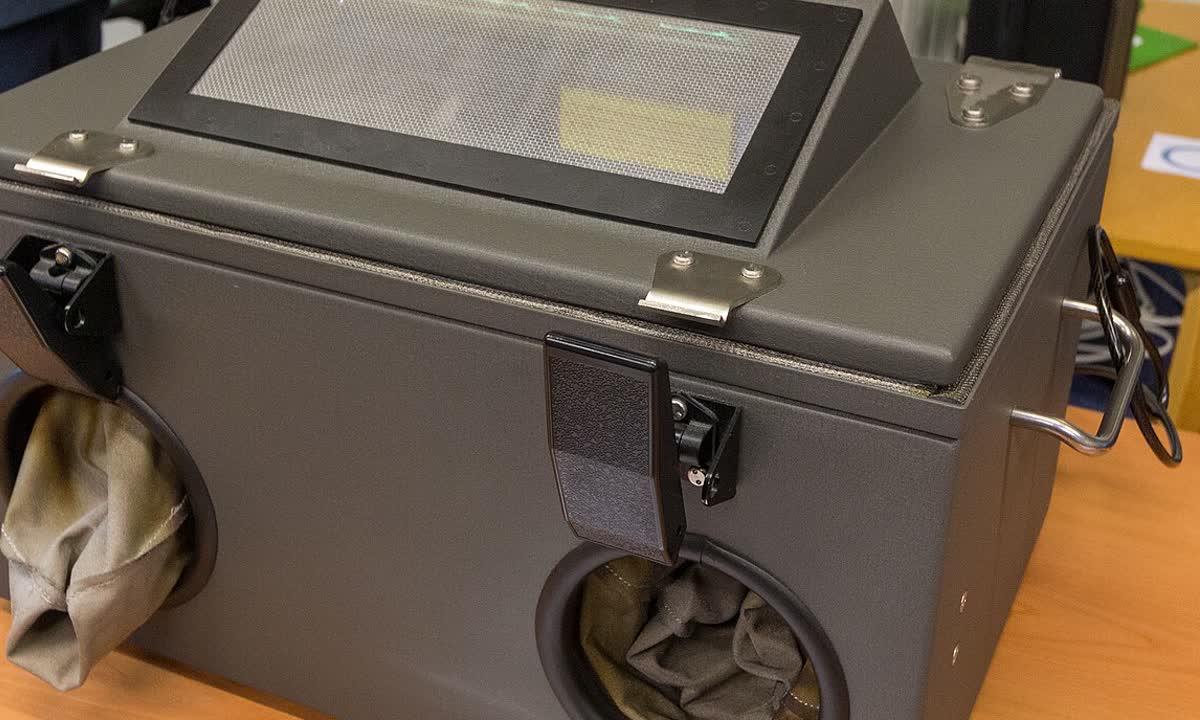
The EMF blockers with a measurable effect are the ones that put conductive material all the way around a device, or squarely between the device and you. A sealed Faraday pouch is the easiest to check, because your phone loses service while it's inside. Stickers, chips, pendants and plug-in "neutralizers" have no effect anyone has shown, and the FTC has been saying so since 2002.
This guide is about what products physically do to a radio signal, not about health. The FDA says the weight of scientific evidence hasn't linked cell phone radio frequency radiation with any health problems (page current as of May 2021). And "radiation" here means radio waves, which the National Cancer Institute places in the non-ionizing, low-energy part of the spectrum.
Do EMF blockers actually work?
Some do. The dividing line is whether there's a physical mechanism you can test.
| Product type | How it works | What it can do | How you check it | Our take |
|---|---|---|---|---|
| Faraday pouch, bag or box | Conductive material closes around the device | Cuts the device off from the network while sealed | Seal the phone in, then call it and text it | Works if sealed; test every one |
| Shielding fabric, paint or window film | A conductive layer between a source and you, rated in dB | Weakens signal crossing that surface | Ask for the dB figure, the frequencies and the test method | Real effect, for sources on the far side only |
| Flip case with a shielding flap | A metallized flap over the screen side | At most, weakens signal on the flap side | No home test, since the phone keeps working by design | Directional at best; ask for test data |
| Sticker, chip, pendant, plug-in "neutralizer" | No mechanism that has been measured | Nothing shown | There's nothing to measure | Skip it |
How do you test an EMF blocker yourself?
For anything that encloses the phone, the test is a phone call. Seal the phone inside, wait a minute, then call it and send it a text from another phone. If either one gets through, the enclosure leaks.
Send the text even if the call fails. NIST's 2014 mobile device forensics guide describes a Purdue University field test of phone shielding devices on three big US carriers. In most test cases the shielding didn't stop all network traffic, and SMS messages got through most often, then voice calls. NIST gives three reasons a shield fails: the material doesn't attenuate enough, there are leaks or seams, or the conductive shield itself acts as an antenna. It tells examiners to test their own products before relying on them, and we'd say the same to anyone buying one.
Products that leave the phone working can't be checked this way, so people reach for a meter. The FCC's engineering guide on RF exposure, OET Bulletin 65, says a proper survey instrument reads the same however you rotate the probe and states its frequency range and accuracy. It also warns that a power density readout close to a source only shows a "far-field equivalent" value. So check that the meter's range covers your band, and take before and after readings at the same spot and angle.
What material can block EMF?
Material that conducts electricity. NIST's forensics guide calls the working part of a phone isolation bag its "conductive shield," and ASTM's test for flat shielding materials measures how much of a radio wave they reflect and absorb. How much a material weakens the signal is its shielding effectiveness, given in decibels (dB). A 2008 paper by NIST researchers defines it by comparing the power inside an enclosure with the power outside.
Decibels are logarithmic. Under NIST's definition, a power level in dB is 10 times the base-10 logarithm of a power ratio. In plain words, every 10 dB cuts what gets through by another factor of 10. So 20 dB lets 1/100 of the power through and blocks 99%, and 30 dB lets 1/1,000 through.
Our calculation, not a product test. Share of incoming power that passes = 10^(-dB/10). The share blocked is 100% minus the number shown: 90%, about 95%, 99%, 99.9%, 99.99% and 99.9999%. Each 10 dB cuts what gets through by another factor of 10.
| Shielding rating | Share of power that gets through |
|---|---|
| 10 dB | 10% (1 in 10) |
| About 13 dB: NIST test box with a narrow slot, measured in 2008 | about 5% (1 in 20) |
| 20 dB | 1% (1 in 100) |
| 30 dB | 0.1% (1 in 1,000) |
| 40 dB | 0.01% (1 in 10,000) |
| 60 dB | 0.0001% (1 in 1,000,000) |
Calculation from the decibel definition in NIST SP 811, section 8.7. The 13 dB row is the shielding effectiveness reported by NIST researchers for a small enclosure fitted with a narrow-slot panel (Holloway et al., IEEE Transactions on Electromagnetic Compatibility, November 2008).
Then check which test produced the number. ASTM D4935, the ASTM test method for flat materials, is valid from 30 MHz to 1.5 GHz. The FCC describes the 2.4 GHz and 5.8 GHz unlicensed bands as the home of Wi-Fi and Bluetooth, which puts both above that range. A D4935 result alone won't tell you how a fabric does against your router, so ask for data at your devices' frequencies. Room-size enclosures have their own method, IEEE 299, covering 9 kHz to 18 GHz.
Placement limits even a well-rated material. A shielded wall does nothing about the phone on your desk, which is on your side of it, and it can weaken that phone's link to the tower. The FCC says phones run at the minimum power needed to stay connected, and FDA's 2020 consumer page said a weak signal makes them boost it. Our home guide covers walls and windows.
What is the most effective material for electromagnetic shielding?
There's no single winner, and in practice the gaps can matter more than the material. In that 2008 NIST paper, a small test enclosure measured about 13 dB with a narrow-slot panel fitted in its opening. By our calculation that still blocks about 95% of the power, but it lets through about 1 part in 20, roughly 50 times what a 30 dB shield would pass.
For fabrics and films, compare dB at the same frequencies and by the same test method. Then look at the finished item for openings and seams, which NIST lists among the reasons shields fail.
Are Faraday pouches worth it?
A Faraday pouch link soon is the one blocker you can prove works at home. When it's sealed, the phone can't reach a network. That suits a phone you're storing, overnight or in a drawer.
Two catches. NIST notes that a phone cut off from the network turns its signal strength all the way up while it looks for a tower, so the battery drains fast. And a pouch that isn't closed properly can leak, which you won't see from the outside. Do the call-and-text test the day it arrives, and repeat it now and then.
Do flip cases with a shielding flap work?
The evidence for cases is thin. FDA's 2020 consumer page said studies found that shielding products, special phone cases among them, mostly fail to work as advertised and can interfere with the phone. A good flap still has a geometry problem. The FTC's 2011 consumer alert pointed out that the entire phone emits, and a flap covers one face. It can only weaken signal on its own side, and only while it's closed and facing you.
You can't test one at home, since the phone keeps working through the open sides. Ask the seller for a dB figure through the flap at your phone's frequencies, with the test method named. Without that, we'd treat it as an ordinary case and pay ordinary-case money for it.
Do stickers, chips and pendants block EMF?
No one has shown that they do. In 2002 the FTC charged two companies selling phone patches whose ads said they blocked up to 99% of radiation. The director of its Bureau of Consumer Protection said there was "no scientific evidence that their products work as they claim," and independent tests cited in the FTC's announcement found no reduction in exposure. Settlements in 2003 barred blocking claims without competent and reliable scientific evidence. In June 2011 the FTC repeated that there's no scientific proof shields significantly reduce exposure.
A "99%" claim is a 20 dB claim, by our calculation, which is a lot to ask of a patch. When a package gives you no number to check, there's nothing to test. Some accessories skip blocking claims altogether, and FDA's 2020 page gave examples of unprovable and misleading accessory claims, such as an "inductor coil" that suppresses harmful frequencies. Our sticker guide goes through the lab tests.
How to make your own EMF blocker
The free version is already on your phone. In NIST's forensics guide, a shielded container is only one of three ways to take a phone off radio networks. The other two are airplane mode and turning the phone off, and NIST notes that airplane mode doesn't always stop the phone from using services such as GPS.
You can build a box from conductive material, but without lab equipment you won't know its dB rating. Use NIST's failure list as a build guide: enough attenuation, no leaks or seams, and no cable running through the closure, since NIST warns a cable can act as an antenna. Then run the call-and-text test. Don't wrap a phone you're using, either. The FTC's 2011 alert warned that a shield in the signal's path can push the phone to transmit harder to stay connected.
What lowers exposure without buying anything?
The FCC lists the steps, while noting it "does not endorse the need" for them:
- Spend less time on calls.
- Use speakerphone, an earpiece or a headset. Wired earpieces may conduct some energy and wireless ones emit a little, the FCC says, but both take the phone itself away from your head. A wired headset link soon has no radio of its own.
- Keep the device farther from your body.
- Text instead of calling, though not while driving.
The FTC's alert adds: wait for a good signal, since a phone on a weak one works harder. Don't shop by SAR rating. Every phone sold in the US must meet the FCC limit of 1.6 watts per kilogram, and the FCC says SAR differences between phones are small next to what the steps above achieve.
Distance works on the router too. In the far field, power density falls with the square of distance. Moving your seat from 1 meter to 3 meters away leaves about 1/9 of the power density, about 11%, in that idealized estimate. Our router guide works through it, and an Ethernet cable link soon takes a desk computer off Wi-Fi entirely.
Checklist before you buy an EMF blocker
- If it's a full enclosure, plan to run the call-and-text test the day it arrives.
- Look for a dB figure, the frequency range it was measured at and the test method. If any of the three is missing, skip it.
- Check that the tested range includes your devices' bands, such as 2.4 GHz and 5 GHz for Wi-Fi.
- For fabric, paint or film, make sure the source you care about is on the far side of it.
- Pass on stickers, chips, pendants and plug-ins.
- Before buying anything, give the free steps a week: airplane mode at night and speakerphone for long calls.
If you want one product after all that, make it a pouch, and buy it from a seller that takes returns. Your phone tells you within a minute whether it works.